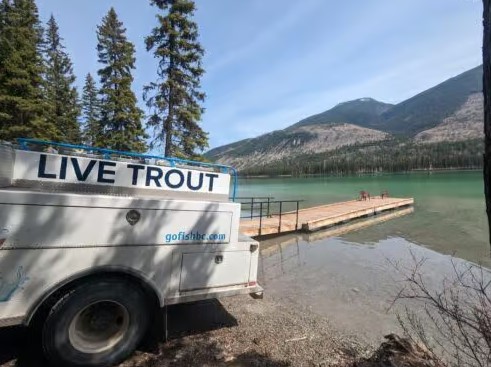
Jen Dunphy / Go Fish BC (FFSBC)
1 of 2
3
Species listed
19.2 m
Reported max depth
9.8 m
Reported mean depth
For a few weeks after the ice goes off Whitetail, the whole lake comes down to its shoals. Most of the basin is shallow enough to grow weed, the flats are floored with pale marl, and when the chironomids start coming up off that bottom the big rainbows leave the deep water and feed in the light.
It is a long way up a logging road west of Canal Flats to get there, and people have been making the drive for trophy rainbows for decades.
The lake is one basin: a deep middle, ringed by a wide shelf of shallows and broken up by points and bays. It fishes as three places. There is the shore in front of the campground, where you launch.
There are the flats and the shallow south end. And there is the drop off the points, where fish go once the flats warm. Most of the shoreline beyond the campground is private, so you fish it from a boat.
Start in front of the campground on the west shore. The launch is there, a shoal runs off the camp, and you can anchor within sight of your tent and fish a chironomid over the edge of the weed in the first weeks after ice-off. It is busy in May and June, and there still seems to be room on the water.
The south end is the part to row to. It is shallow, and there is a shoal off it and a bay where fish have been seen cruising. On a calm morning in June, when the mayflies and damsels are moving, this is where a leech or a nymph worked slowly along the marl edge earns its keep.
The drop off the points is the summer and autumn water, and the one most people leave too early. When the shallows warm, fish hold along the break where the shelf falls into the basin. Evenings run late here, and a sedge dry skated on the surface has taken fish in September, long after the June crowd has gone home.
A boat-only campground on the eastern shore is the best camp on the lake, and the reason to bring something you can row across. When Whitetail has had its turn, Alces Lake is the next rainbow water near Canal Flats.
Fish in this water
Each fish is rated by its strongest evidence. A rating says how sure we are a fish is here, not how many there are, whether it is worth fishing for or whether you may keep it.
Confirmed
Recorded on this water in the last 15 years, or named for it by a fishery agency, its fishing rules or a fishing publication.
Likely
Older records here, recent stocking, a local guide or fly shop, a guide listing, or recent records on connected water nearby.
No live gauge
No gauge readings are available for this water.
Season
Driving directions
Water and habitat
Whitetail is a moderately rich lake with a big share of shoal for its size, and that shelf is the engine of the fishery: weed, marl, and the insects that live in both. Fish feed on the flats when the water is cool and back off to the drop-offs and the deep middle as summer heats the shallows.
The weed beds have thinned over the years, and the fish are thought to have run bigger when the weed was thicker. The points matter most, because they put deep and shallow water within one cast of each other, and they give you somewhere to hide from the wind.
Fish and forage
Brook trout are reported too. The fish eat chironomids from ice-off, then dragonfly and damselfly nymphs, Callibaetis mayflies and freshwater shrimp, with leeches all season, and big travelling sedges hatch in June.
Carry chironomid pupae in black, red and olive, and balanced or bead-head leeches in black and green. Add a damsel nymph, a dragonfly nymph, a scud and a few sedge dries. A white muddler or woolly bugger has taken good fish when nothing on the shoal was working.
When to fish it
The rules list no closed season for Whitetail Lake. Check in-season changes before you go. Ice-off through June is the main event, with chironomids first, then the mayfly, damsel and sedge hatches stacking up into early summer.
That is also when the campground fills. July and August push fish deep, and the good fishing shrinks to early morning and evening along the drop-offs. September brings the lake back.
The fish feed again in cold nights and short days, and the campground is quieter.
How to fish it
Anchor at both ends on the edge of a shoal, with your back to the wind, and cast downwind so the line doesn’t belly. Fish one chironomid under an indicator, set so the fly hangs just off the bottom, and lengthen the leader until you are touching weed, then shorten it a little.
If nothing happens in twenty minutes, change the colour before you change the spot. If that fails too, take the indicator off and swap to a leech or a damsel nymph. Count it down on a sinking line and strip it back slowly over the marl edge.
When fish are moving but won’t take, a slow hand-twist retrieve on a scud or a small nymph often does what stripping won’t. Through summer, move out to the break off the points and fish the same fly deeper. In the evening, try a sedge dry skated on the surface, or a white streamer stripped off the drop-off.
Wind is the thing that beats people here. It can shut down exposed water for hours. Tuck in behind a point and fish the lee side rather than fighting it.
Access and safety
The lake is about 28 km of gravel west of Highway 93/95. Turn west onto the Findlay Creek Forest Service Road 4.5 km north of Canal Flats, follow the signs toward Blue Lake Forestry Camp, keep right past the Blue Lake turn, and turn right again near the 28 km mark. Allow about 40 minutes from Canal Flats.
It is an active, radio-controlled logging road. Drive it with your lights on, call your kilometres if you carry a radio, and give loaded trucks the road. A two-wheel-drive vehicle and a trailer will make it, but potholes can be bad between gradings.
The recreation site is on the west shore. It has a cartop launch, pit toilets and a day-use area at the north end.
The first group of sites takes trailers. The second group, to the south, has no trailer turnaround. Canal Flats is the nearest place for supplies.
Nights get cold in spring and autumn, so bring warm clothes and a way to heat a tent. In a cartop boat, don’t try to cross the open middle when the wind gets up.
Regulations
On Whitetail Lake, the rainbow trout daily quota is 1, none under 50 cm.
•
The brook trout daily quota is 20.
•
The possession quota in the region is 2 daily quotas.
•
A bait ban and single barbless hooks apply.
•
There is no ice fishing and no towing.
•
Your licence lets you fish one artificial fly on a line, so fish one fly at a time.
•
Check the current Region 4 synopsis and in-season changes before you fish.
•
The creek that drains the lake is a stream with its own rules, so check the regulations before you cast there.
Popular waters nearby
Related
Whitetail Creek
Columbia River
Premier Lake
Whiteswan Lake
Chironomid Under Indicator
Small-Lake Stillwater
BC fishing regulations
British Columbia’s freshwater fishing rules by topic: daily limits, catch and release, harvest, Classified Waters and in-season changes, each with the synopsis page that prints it.
Page reviewed 2026-10-28